
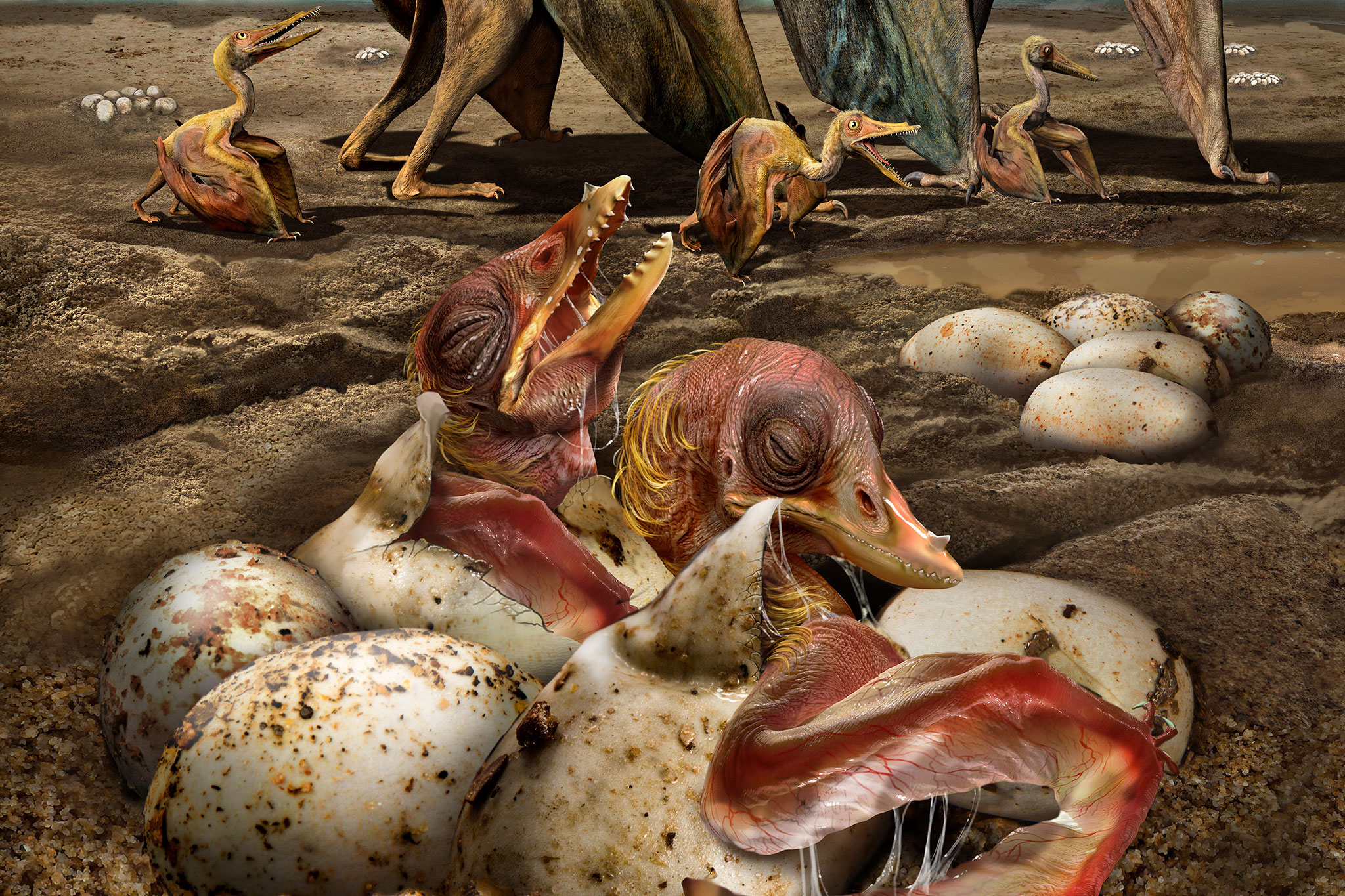
The well-preserved eggs illuminate how the winged reptiles bred—and how their babies may have behaved.
 In a world first, paleontologists working in northwestern China have discovered a cache of hundreds of ancient eggs laid by pterosaurs, the flying reptiles that lived alongside the dinosaurs. Some of the eggs contain the most detailed pterosaur embryos ever found.
Although scientists have studied pterosaurs for more than two centuries, no eggs were discovered until the early 2000s, and fewer than a dozen turned up in the intervening years. The new haul, discovered by Chinese Academy of Sciences paleontologist Xiaolin Wang, includes at least 215—and perhaps as many as 300— stunningly preserved pterosaur eggs.
His team also found 16 embryos within the eggs, and they suspect that more remain locked away in the stone. Wang and his colleagues announced the finds today in Science.
We get a lot of hyperbole in paleontology, but it’s pretty phenomenal,” says David Hone, a researcher at Queen Mary, University of London who wasn’t involved with the study. “The science is at the absolute start, but the mere raw material is game-changing, potentially.
THE PERFECT STORMS
The newfound eggs belong to Hamipterus tianshanensis, a previously known species of pterosaur that lived in northwestern China more than a hundred million years ago. With a maximum wingspan of 10 feet and a probable taste for fish, these animals may have resembled today’s herons, living near waters that crisscrossed inland terrain.
“The site is in the Gobi desert, and there are strong winds, a lot of sand, with few plants and animals,” says study coauthor Shunxing Jiang of the Chinese Academy of Sciences. “However, when Hamipterus lived, the environment [was] much better—we call it Pterosaur Eden.” (Find out how scientists are fighting fossil poachers in the Gobi.)
Wang’s team suggests that an ancient nesting site may have flooded repeatedly. This would imply that, like modern birds and turtles, Hamipterus used the same nesting sites over and over. What’s more, the sheer number of eggs suggests that Hamipterus bred in large groups like some living birds.
LEAVING THE NEST
As the waters raged on that ancient Chinese lake, many of the pterosaur eggs split open, letting in sediments that ultimately preserved their oblong shapes. And in at least 16 of these eggs, the sediments also cradled the delicate skeletons of developing pterosaur embryos, including one bone that the team thinks belonged to a hatchling.

The Hamipterus fossil site, located in the Xinjiang region in northwestern China, has yielded hundreds of pterosaur bones.
PHOTOGRAPH BY ALEXANDER KELLNER, MUSEU NACIONAL, UFRJ
“We could look at the bones and see what features characterize an embryo, a hatchling, and a young individual when he’s matured,” says coauthor Juliana Sayão, a bone-structure expert at the Federal University of Rio de Janeiro. “This is a one-of-a-kind record for pterosaurs—for the first time, we have the whole spectrum.”
By comparing isolated bones from pterosaurs of different ages, researchers can roughly piece together how Hamipterus developed. They found that the late-stage embryos didn’t yet have teeth, and their forelimbs were less developed than their hind limbs. The seemingly weak arms came as a surprise, because many paleontologists thought that pterosaurs were fliers nearly straight out of the egg. The Hampiterusfossils, however, imply a slower-growing pterosaur that scampered around on all fours as an infant.
“I think they have a good argument, [and] it’s an interesting result,” says University of Southern California paleontologist Mike Habib, an expert on reconstructing how pterosaurs moved. He hopes that future work on these fossils will use mechanical analysis to test how well the small reptiles might have actually flown. (See a pterosaur that may be one of the largest animals ever to fly.)
