

 ADX Florence rises from the high desert of southern Colorado like a concrete fortress built to swallow sound.
The prison sits about 100 miles south of Denver, surrounded by razor wire, gun towers, electronic surveillance and miles of empty landscape. There are no crowded prison yards, noisy cellblocks or inmates shouting across a cafeteria.
There is no cafeteria.
Meals arrive through slots in steel doors. Recreation often means walking alone inside a concrete enclosure. Human contact is measured in minutes, monitored through cameras, and granted based on behavior.
Officially, it is the United States Penitentiary Administrative Maximum Facility. Most people call it ADX, the federal supermax—or the “Alcatraz of the Rockies.”
It is where the federal government sends men considered too violent, influential, disruptive or escape-prone for an ordinary maximum-security prison.
How many inmates live at ADX?
- Current population: Approximately 407 men
- Rated capacity: Approximately 490 inmates
- Housing: Primarily single-person cells
- Population changes because of transfers, deaths and releases
 The Federal Bureau of Prisons currently reports approximately 407 inmates at ADX Florence.
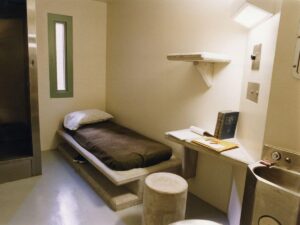
Each man occupies a tightly controlled world of concrete, steel and electronic locks. Inside a typical cell are a concrete bed, a desk, and a stool, along with a stainless-steel sink and a toilet. A narrow window offers light but little sense of location.
The silence is intentional. The architecture is designed to prevent prisoners from seeing one another, communicating across cellblocks or determining exactly where they are inside the complex.
Doors open remotely. Cameras watch continuously. Every movement is planned before the inmate leaves his cell.
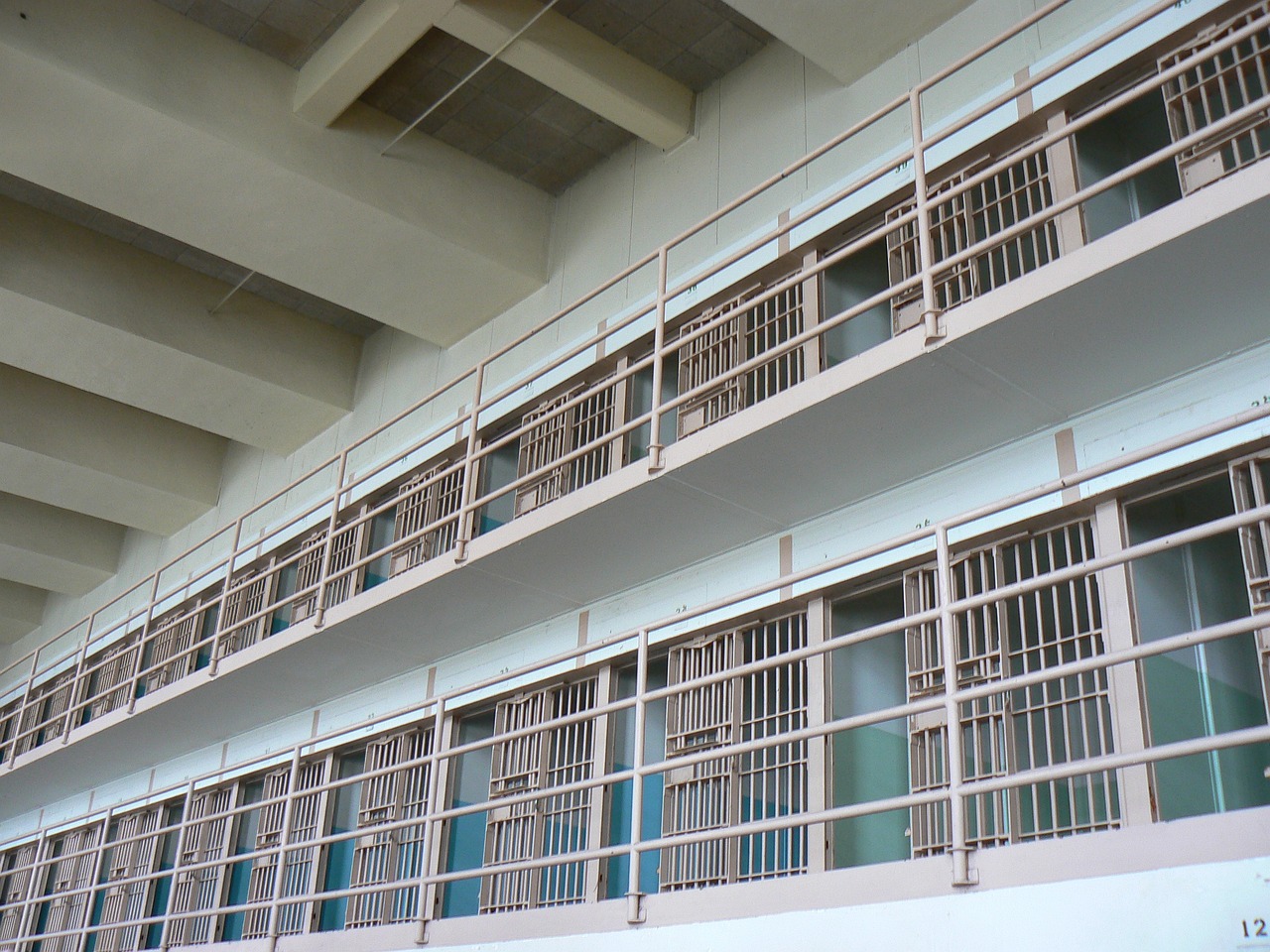 BOP population statistics
What is the average sentence?
- The BOP does not publish an ADX average
- Many inmates are serving life without parole
- Some are serving multiple consecutive life sentences
- Others have fixed sentences ranging from years to decades
- A small number are under federal death sentences
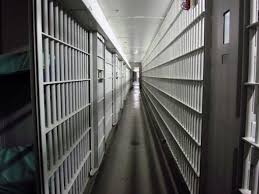 There is no reliable published average sentence for ADX prisoners—and even if someone calculated one, the number would be misleading.
How does anyone average six life sentences against 240 years? What number should be assigned to life without parole?
The prison holds men whose sentences read like grim pieces of arithmetic: life plus 30 years, four life terms plus 50 years, 161 consecutive life sentences.
But ADX is not itself a sentence. It is a security designation. An inmate may be sentenced to federal prison and later transferred to ADX because of an escape attempt, prison murder, gang leadership or an ability to direct violence from behind bars.
If his behavior improves, he might eventually leave ADX—but usually through a transfer to another prison, not through the front gate.
How many inmates are paroled each year?
- Modern federal prisoners generally are not eligible for parole
- Congress abolished federal parole for most crimes committed after Nov. 1, 1987
- The BOP does not publish an ADX-specific annual parole figure
- Most men who leave ADX enter another federal prison
- Some older federal and District of Columbia cases remain exceptions
For most ADX inmates, parole is not waiting at the end of a long institutional hallway.
It does not exist.
ADX INMATES:
Congress abolished parole for nearly all federal crimes committed after Nov. 1, 1987. A federal prisoner may receive limited credit for good conduct or qualify for other sentence reductions, but that is different from appearing before a traditional parole board.
Some older federal prisoners and certain District of Columbia offenders remain eligible. For the overwhelming majority, however, leaving ADX means being moved to a less restrictive federal institution.
Their chains come off in stages. Their sentences do not.
Do inmates have books?
- ADX provides library services
- Inmates can request books delivered to their units
- Approved publications may be received through authorized sellers
- All materials are inspected
- Security classifications and SAMs can limit access
Books are among the few doors that do not require a correctional officer to unlock them.
Inmates can request titles from the prison library. Workers collect the requests, locate the books and send them into the housing units on carts. Approved books and publications may also arrive from publishers, bookstores or authorized distributors.
Everything is inspected. Publications can be rejected if officials believe they contain prohibited material, coded communications or information posing a security threat.
For men confined inside small concrete rooms, reading can become more than recreation. A book can turn a wall into a window and make several hours disappear.
A former ADX library worker described delivering books and even organizing quizzes for prisoners in The Marshall Project.
How much recreation do inmates receive?
- Special Housing Unit: At least five hours weekly
- Control Unit: At least seven hours weekly
- Special Security Unit: Generally at least 10 hours weekly
- General population: At least 10½ hours weekly
- Intermediate step: Approximately 20½ hours weekly
- Alternative housing: At least 24 hours weekly
- Final step-down stages: Approximately 30½ to 35½ hours weekly
 At ADX, recreation does not necessarily mean freedom beneath an open sky.
For prisoners in the most restrictive units, it may mean being handcuffed, escorted through a series of electronically controlled doors and placed alone inside a secure exercise enclosure. The walls are high. The equipment is sparse. Another inmate may be only a few yards away and still remain unseen.
The amount of recreation depends on an inmate’s unit, disciplinary record and progress through the step-down program.
Prisoners beginning in restrictive housing may receive only five to 10½ hours outside their cells each week. Men who demonstrate years of acceptable behavior can earn additional time and limited interaction with carefully selected groups.
The prison does not suddenly become open. It becomes less closed.
The Justice Department describes the different housing programs in its report on ADX and restrictive housing.
Can inmates watch television or listen to radios?
- Televisions are generally available in regular ADX cells
- Programming is controlled by the institution
- Educational and religious programs may be shown
- Entertainment and news may be available
- Radios may be permitted under property rules
- Privileges can be restricted or revoked
- Disciplinary-segregation inmates may lose television access
A television inside ADX is not a connection to the world without conditions. It is a privilege controlled from outside the cell.
General-population cells normally have televisions carrying institution-approved news, entertainment, educational and religious programming. Some psychological and educational programs are delivered over closed-circuit television because gathering prisoners inside classrooms would present a security risk.
Radios may also be permitted, subject to institutional rules. These devices can be restricted or taken away for disciplinary reasons.
In administrative detention, a television may show institutional announcements and approved programming. In disciplinary segregation, the screen may remain dark.
What do ADX inmates eat?
- Three meals are generally served daily
- Meals are delivered to the cells
- There is no general inmate dining hall
- Meatless and no-pork alternatives are available
- Approved religious diets may be provided
- Heart-healthy options appear on the national menu
Breakfast might include oatmeal, cereal, fruit, wheat bread and milk. Lunch or dinner could be roast beef with mashed potatoes, chicken fajitas with rice and beans, pasta and meatballs, tacos, baked chicken, fish or pizza.
The food is prepared elsewhere and brought through the corridors on carts. A tray slides through the opening in the door. The inmate eats alone, often within arm’s reach of his bed and toilet.
The BOP operates a rotating national menu with regular, meatless, no-pork, heart-healthy and approved religious choices. The most readily available published version is dated fiscal 2020, so individual meals may have changed.
How often do inmates receive mail?
- Mail is normally delivered Monday through Friday
- There is ordinarily no delivery on weekends or federal holidays
- Letters should generally be delivered within 24 hours after inspection
- General correspondence is opened and examined
- Properly marked legal mail is opened in the inmate’s presence
- SAMs can impose extraordinary communication restrictions
Mail ordinarily moves through ADX five days a week, but no envelope travels directly from the outside world into an inmate’s hands.
It is opened, inspected and examined for contraband, threats, coded instructions and evidence of criminal activity. Properly identified legal mail receives special handling and is generally opened in the prisoner’s presence.
For inmates under Special Administrative Measures, even an innocent sentence can receive close scrutiny. Communications may be delayed, limited or rejected when officials believe they threaten public safety, national security or prison operations.
The envelope crosses the prison walls. Privacy usually does not.
What happens when an inmate dies at ADX?
- Medical personnel respond and pronounce the death
- The cell or death scene is secured
- Possible evidence is preserved
- The FBI may investigate suspicious or violent deaths
- The coroner determines whether an autopsy is required
- The BOP notifies the designated contact or next of kin
- The inmate’s property is inventoried
- The remains may be released to the family’s funeral home
Death does not immediately unlock the doors.
Medical employees respond first. Once the inmate is pronounced dead, officers secure the area. If the death is violent, unexplained or suspicious, the cell becomes a potential crime scene. Evidence is preserved, witnesses may be interviewed and the FBI can become involved.
The coroner or medical examiner assumes responsibility for determining the cause and manner of death. An autopsy may follow.
 The BOP then attempts to contact the person designated by the inmate or his next of kin. After officials complete the necessary examination and investigative work, the body can be released to a funeral home chosen by the family.
The dead man’s possessions—letters, photographs, legal papers and whatever else remained inside his concrete world—are inventoried and processed for return.
Is there a cemetery at ADX?
- No publicly identified inmate cemetery exists at ADX
- There is no evidence that prisoners are routinely buried on the grounds
- Claimed remains can be released to a family-selected funeral home
- Unclaimed remains may be buried or cremated through local arrangements
- The BOP has not published a single automatic rule for every unclaimed body
There is no known cemetery behind the razor wire at ADX Florence—no field of numbered stones marking the men who entered the prison and never came out alive.
When a body is claimed, the family generally works with a funeral home to arrange transportation and final disposition.
When nobody claims it, the matter passes into a quieter bureaucratic world involving the BOP, the coroner, local authorities and funeral providers. Depending on the circumstances, governing law, expenses, religious considerations and any known wishes of the deceased, the body may be buried or cremated.
Public records do not establish that all unclaimed ADX prisoners are cremated. Nor do they show that the dead are buried in a secret prison graveyard.
The prison was constructed to hold living men whom the government considers exceptionally dangerous. When one of them dies, however, the same fundamental questions remain: Who will claim him? Who will bury him? And who, if anyone, will remember where he went?