

 LOS ANGELES — A former AT&T retail employee who secretly transferred customers’ cellphone numbers to devices controlled by criminals was sentenced Tuesday to 16 months in federal prison.
Kenneth Carter, 44, of Portland, Oregon, exploited his access to AT&T’s network to help a hacker seize control of customers’ phone numbers, intercept security codes and break into their bank accounts, according to the U.S. Attorney’s Office for the Central District of California.
The scheme targeted at least three victims and caused an intended loss of $593,963.
U.S. District Judge Stanley Blumenfeld Jr. also ordered Carter to pay $99,528 in restitution.
Carter pleaded guilty March 24 to one count of conspiracy to commit wire fraud and bank fraud.
How the SIM-swap scheme worked
 From May 2018 through November 2019, Carter worked at an AT&T retail store in Portland. A co-conspirator selected victims with online bank accounts and provided Carter with their cellphone numbers and personal identifying information.
Carter then used his employee access to transfer — or “swap” — a victim’s phone number to a cellphone controlled by members of the conspiracy.
That transfer allowed the criminals to receive the victim’s password-reset messages and two-factor authentication codes. Armed with those codes, the conspirators could enter the victim’s bank account and attempt fraudulent wire transfers.
Carter typically received between $1,000 and $2,000 for each SIM swap. One of the fraudulent transfers was carried out at an AT&T store in Lancaster, California.
Nearly $100,000 sent overseas
 Federal agents searched Carter’s Oregon residence in November 2019 and found personal information belonging to victims, including names, cellphone numbers and Social Security numbers.
The information included records belonging to a victim whose bank account was drained of $99,528. The money was transferred to a Portuguese bank account controlled by Carter’s co-conspirators.
Banks stopped other attempted transfers before the money could be sent overseas, limiting the victims’ actual losses. Carter admitted that he also conducted SIM swaps involving additional AT&T customers.
AT&T fired him in 2019.
Prosecutors said Carter betrayed his employer’s trust by selling access to the company’s network and enabling a hacker to take control of customers’ accounts.
The FBI, IRS Criminal Investigation and the FDIC Office of Inspector General investigated the case. Assistant U.S. Attorneys Andrew M. Roach and Nisha Chandran prosecuted it.

Source: FBI
What Is SIM Swapping?
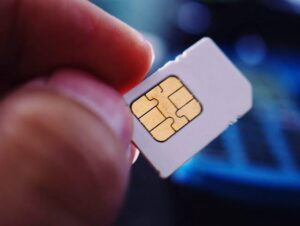
SIM swapping does not necessarily require someone to steal a victim’s physical SIM card.
Instead, a criminal tricks or bribes a mobile carrier employee into transferring the victim’s phone number to another device. Calls and text messages — including banking security codes — are then routed to the criminal.
The FBI recommends using an authentication app, biometric verification or a physical security key instead of relying solely on security codes sent by text message.
Fact Checklist
🔴 Defendant: Kenneth Carter, 44, of Portland, Oregon
🔴 Prison sentence: 16 months
🔴 Restitution: $99,528
🔴 Crime: Conspiracy to commit wire fraud and bank fraud
🔴 Scheme: Fraudulent SIM swaps
🔴 Intended losses: At least $593,963
🔴 Victims identified: Three, plus other AT&T customers
🔴 Payment per SIM swap: Typically $1,000 to $2,000
🔴 Federal judge: U.S. District Judge Stanley Blumenfeld Jr.
🔴 Investigating agencies: FBI, IRS Criminal Investigation and the Federal Deposit Insurance Corp. Office of Inspector General
Related Videos
- ABC News: SIM-swap scams netted $68 million in 2021 — Includes a 1-minute, 44-second video explaining the fraud.
- How to Avoid SIM-Swapping Scams — Consumer-focused news report explaining warning signs and protective measures.