
“I had always hoped that this land might become a safe and agreeable asylum to the virtuous and persecuted part of mankind.” — George Washington — First U.S. president, 1788
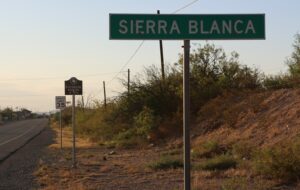
SIERRA BLANCA, Texas — The notebook lay inside a solitary railroad boxcar where, just hours earlier, authorities had removed 18 bodies.
Empty water containers, scattered food, discarded clothing and dried blood remained inside — grim evidence of the horror that had unfolded there.
Earlier that sweltering summer day, July 2, 1987, The Associated Press reported that 18 bodies had been discovered inside a boxcar that had departed El Paso hours earlier.
At the El Paso Herald-Post, photographer Billy Calzada grabbed his camera gear, I snatched my reporter’s notebook, and we rushed out of the newsroom.
We headed east on Interstate 10 toward Sierra Blanca, a small West Texas town about 86 miles from El Paso.
We stopped at the sheriff’s station, where several officers were milling around.
I asked one of them where we could find the boxcar.
He told us to drive about a mile down the road, parallel to the railroad tracks. We couldn’t miss it, he said.
The bodies had already been removed.
“Where are the bodies?” I asked.
“Some are right behind you,” he replied.
I turned around.
About 20 yards away, a line of hearses sat parked nearby. The rear door of one was open. Inside were three black body bags.
We got back into our vehicle and followed the officer’s directions.
Initially, we drove right past the lone boxcar.
We had expected a major crime scene, with sheriff’s deputies, U.S. Border Patrol agents and investigators examining the railroad car.
Instead, there was nothing.
Not a patrol car. Not an officer. Not even a strip of yellow crime-scene tape.
From the road, the boxcar appeared empty and abandoned.
We continued driving for nearly two miles before making a U-turn.
We returned, pulled over and got out.
The railroad tracks stretched into the distance. There were no other boxcars in sight.
We walked down a small hill toward the open railroad car.
Birds chirped in the summer heat.
 As we approached, we heard the buzzing of flies swarming around the boxcar.
I looked down the tracks in both directions.
“I guess this is it,” I told Billy.
We peered inside.
Clothing, food containers and other belongings were scattered across the floor. Dried blood stained the wooden floorboards and steel walls.
The smell of urine lingered in the air.
Billy wondered whether we were allowed inside. He expected authorities to arrive at any moment.
“There’s no crime-scene tape. Everybody left,” I said.
I hoisted myself into the boxcar.
The Notebook
Standing in the middle of the railroad car, I began writing in my reporter’s notebook, describing what I saw.
Then I glanced down.
Near my foot, partly concealed beneath an old jacket, lay the notebook.
I knelt, pulled it from beneath the clothing and opened it.
Someone had used it as a diary, recording thoughts, poetry and personal reflections.
The entries were written in Spanish.
I began reading.
Within moments, I became absorbed in the words.
Other reporters had begun arriving at the boxcar, but I barely noticed them. I could hear voices around me, yet I remained focused on the notebook.
Someone standing nearby asked what I was holding.
I looked up.
A television cameraman had his camera pointed directly at my face and the notebook.
“It’s some writing, a notebook,” I replied before returning to the pages.
“What does it say?” he asked.
“A lot of things,” I answered.
And I kept reading.
On the drive back to El Paso, Billy and I discussed what we had seen.
I pulled out the notebook.
“Look, check it out,” I said, telling him about some of the entries I had read.
“And we got it,” I added.
Before Billy could respond, I explained my reasoning.
“Look, they’re probably going to sweep the boxcar out, put everything into plastic bags and toss all that stuff into a dumpster. It’s nothing but trash to them.”
But to me, the notebook was anything but trash.
It contained something far more valuable than the scattered belongings left inside the railroad car.
It offered a glimpse into the lives of people who had died trying to reach a better future.
The Lone Survivor
 According to authorities, a human smuggler — commonly known as a coyote — had placed 19 people inside a railroad boxcar in downtown El Paso.
Before closing the door, the smuggler tossed a five-inch railroad spike inside.
Then he left.
The train headed east across the West Texas desert.
As temperatures soared, the boxcar became an oven.
The journey from El Paso to Sierra Blanca lasted approximately 14 hours.
Inside the railroad car, the passengers struggled to survive as temperatures reportedly climbed to 120 degrees.
“The lack of air plus the extreme heat — it must have been an excruciating death,” Bill Harrington, then assistant chief patrol agent for the Border Patrol in El Paso, told the Herald-Post.
“They had heat convulsions. There was a lot of blood inside the car.”
Of the 19 people trapped inside, only one survived.
His name was Miguel Tostado Rodriguez.
He was 21 years old.
Using the five-inch railroad spike, Tostado Rodriguez managed to carve a hole approximately one foot long through the thick wooden floor of the boxcar.
He survived by placing his mouth and nose near the opening to breathe.
I squatted on the floor and pressed my hand against the heavy wooden boards.
They were thick and hard.
I tried to imagine the effort required to punch through them with nothing more than a railroad spike.
A Border Patrol agent told me that Tostado Rodriguez had worked for nearly two hours before finally breaking through the floor.
His resourcefulness, determination and patience probably saved his life, the agent said.
Eighteen others were not so fortunate.
The Border Patrol Agent
Stanley Saathoff, a Border Patrol supervisor, was on duty when the train was stopped for a routine inspection in Sierra Blanca.
Saathoff was searching for people who had entered the United States illegally.
He walked along a long line of railroad boxcars, checking for signs of anyone hiding inside.
As he approached one of the cars near the end of the train, he heard something.
A voice.
Someone was crying out desperately for help.
“He said, ‘We need help. Could you help us? Can you please help us? We need help,'” Saathoff recalled.
The man inside spoke very good English, he said.
Saathoff opened the boxcar door.
Tostado Rodriguez stood before him.
Behind the young survivor lay 18 bodies.
“Their feet and their hands were white,” Saathoff said. “Body fluids had released — stiff bodies. Blood was dried. Some of them bled a little. So I determined that they were dead.”
The desperate cries Saathoff heard had led him to the only person still alive inside the boxcar.
The Story Behind the Deaths
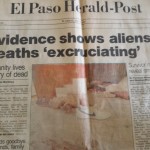
The following day, July 3, 1987, the Herald-Post published my account alongside reports from other journalists.
The headline stretched across the page in bold type:
“Evidence Shows Aliens’ Deaths Were ‘Excruciating.'”
I wrote, in part:
“Apparently, the aliens knew that their journey was going to be long, arduous. They had prepared for it.
“Food for the trip and plastic water containers were scattered around the car — bearing the Spanish Del Monte Corn label — stood near one of the doors. Two other cans of corn, neatly wrapped inside a light brown plastic bag, could be seen nearby.
“One of the passenger’s carried a large transparent plastic bag full of animal crackers. Plastic one-gallon milk containers, probably used to carry water, were empty. The containers looked like they had been flung across the boxcar. Some were crushed.
“Authorities said the occupants, in an effort to ward off the 120-degree heat inside the rail car, had taken off their clothes to cool themselves.”
But there was another story inside that boxcar.
It was contained in the notebook I had discovered beneath the jacket.
The Poems, Letters and Dreams of the Victims
Before writing my story that evening, I handed the 55-page notebook to Eduardo Paz Martinez, the Herald-Post’s city editor.
Paz Martinez was fluent in Spanish, and I knew he could provide a more accurate translation of the entries.
What he discovered transformed the notebook from an abandoned personal possession into a portrait of two young men whose lives had ended inside the boxcar.
Their names were Albino Gomez Hernandez and Rosario Caldera Salazar.
Both had written their thoughts in its pages.
“To their relatives in Mexico, they were poets, songwriters, letter-writers and dreamers,” Paz Martinez observed in his newspaper account.
The notebook contained details about their journey, including the money they had spent traveling through Mexico.
“It was important to them to note that they paid 3,500 pesos to get from one small Mexican town to another after they began their journey,” Paz Martinez wrote.
There were also attempts to learn English.
One entry read:
“Justs da strit neim plis.”
Apparently, the writer was practicing the phrase, “Just the street name, please.”
Another entry stated:
“Ai niid tu toc wid dat persen. Aim jis friend.”
The phonetic English suggested someone trying to say, “I need to talk with that person. I’m his friend.”
Paz Martinez believed the writings suggested that Gomez Hernandez and Caldera Salazar had been childhood friends.
The notebook also contained lengthy passages addressed to unnamed recipients.
Some were poetic.
“I found myself in a large garden,” Caldera Salazar wrote. “It was Saturday morning. The day appeared one of promise. The sun shined high, reflecting off the leaves of grass…”
There were pages of mathematical calculations.
One contained the problem 675 multiplied by 72.
“It may be irrelevant to their traveler’s expense but one of them wanted the answer to 675 x 72,” Paz Martinez wrote.
Among the writings was a letter dated Feb. 12, 1987.
It was addressed to a woman named Laura Manuela.
The letter, written by Caldera Salazar, expressed love, longing and the pain of separation.
“My love,” it began.
“This will be in your hands with my anxious desire to again have you close to me. What more could I want than to feel your body, your warmth, your kisses.”
But the letter also revealed heartbreak.
“But I now find out that your sentiments are for another and for that I understand your coldness toward me.”
Caldera Salazar pleaded for reassurance that the woman he loved would return.
“Manuela, tell me when you will return. It doesn’t matter if its take a long time, assure me you will return.”
Then came a reflection on what truly mattered.
“I don’t say I offer you more material things…because material things don’t last. What comes from within lasts an eternity.”
The letter ended:
“That is all from the one who loves you.”
It was signed simply:
Rosario Caldera Salazar.
Two Faces, Two Lives: The Human Legacy
There were no hurriedly scribbled farewell messages in the notebook.
No desperate last words to relatives.
No written expressions of anger or terror from the final hours inside the boxcar.
Whatever the two men had experienced as the temperature climbed and the air became unbearable, the notebook offered no account of those moments.
Instead, its pages preserved something else.
Their lives before the tragedy.
Their friendships.
Their efforts to learn English.
Their poetry.
Their love letters.
Their hopes and dreams.
“No last words for their loved ones. No words of anger. The little diary, probably worth no more than 50 pesos, nonetheless left a valuable amount of information,” Paz Martinez wrote.
“Within its few pages runs the legacy of the illegal alien.”
The notebook helped tell a story that otherwise might have been reduced to a death toll and a few paragraphs about a tragedy in the West Texas desert.
It put names, personalities and emotions behind the statistics.
These were not simply 18 people who had died in a railroad boxcar.
They were human beings with families, friendships, memories and dreams.
Some had left Mexico hoping to escape poverty, earn money and build better lives.
They understood that crossing the border could be dangerous.
But they went anyway.
And like thousands of others who have died along migration routes, they never reached their destinations.
The Notebook’s Final Journey
The story about the notebook was picked up by The Associated Press.
I received telephone calls from The New York Times, The Wall Street Journal and other newspapers asking whether they could obtain copies.
No way, I told them.
It was our story.
Two days later, a Border Patrol agent walked into the Herald-Post newsroom.
He had come for the notebook.
He wanted to return it to the family of one of the victims.
By then, we had made copies.
I handed over the original.
The agent thanked us and quickly departed.
He didn’t question why we had taken it from the boxcar.
Had he done so, we would have had plenty of questions of our own.
But there was no argument.
The notebook was going back to the family.
Nearly four decades later, I remain grateful that I found it and that the Herald-Post published the writings of the two men.
The notebook gave readers something that official reports, casualty figures and crime-scene photographs could not fully convey.
A glimpse into the private lives of two people who had traveled toward the United States with hopes for the future.
Their journey ended inside a railroad boxcar in Sierra Blanca, Texas.
But their words survived.
And for a brief moment, those words allowed the world to see them not merely as migrants who had died, but as people who had lived, loved and dreamed.