
BY RAUL HERNANDEZ
 “You ever heard of the Taco Beat?”
I asked a young Hispanic newspaper reporter that question in 2013 at a National Association of Hispanic Journalists gathering in Anaheim.
He looked at me like a dog staring at a TV set.
Then he shook his head.
We were talking about how journalism was changing. For him, it wasn’t changing fast enough.
“We’ve made a lot of progress. But we still have a long way to go,” I told him.
More than three decades earlier, many Hispanic newspaper reporters believed they had been hired only to add a little color to the newsroom. Most of us were relegated to assignments editors thought we were qualified to handle — the “Taco Beat,” as we called it back then.
 That usually meant covering the barrio, translating for reporters who didn’t speak Spanish or being sent across the border to places like Juarez.
An El Paso Times veteran reporter Diana Valdez Washington found out that Hispanic reporters there were being paid a lot less than the Anglo counterparts.
In the mid-1980s, I was working at the now-closed El Paso Herald-Post when a similar description of work assignments surfaced of all places, the federal courthouse in El Paso.
Hispanic FBI agents alleged they were disproportionately assigned to what they called the “Taco Circuit” and the “Tortilla Circuit.”
The denials rained down in Washington.
FBI officials insisted the bureau treated Hispanic agents fairly, repeatedly defending its practices by citing “the needs of the bureau.”
Hispanic agents filed class-action discrimination lawsuit, initially filed by 331 agents from across the nation in 1988. It landed in U.S. District Judge Lucius Bunton’s court in El Paso.
Hispanic agents testified about the ape ugly and racist side of the agency charged with enforcing the nation’s civil rights laws:
“Louis Barragan, an agent from Sarasota, Fla., testified that he had heard white agents refer to Hispanic colleagues as ‘lazy spics,’ ‘dirty Mexicans’ and ‘lazy Mexican wetbacks.’
A new agent, Alba Lorena Sierra, said she was told by supervisors in her training that she looked ‘too ethnic’ and should buy Vogue magazine for tips on hair styles.”
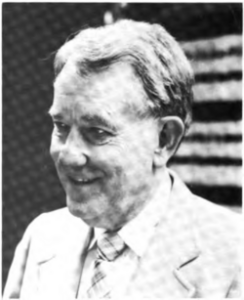
Bunton heard that testimony and more.
He ruled that the FBI had engaged in a “pattern and practice of discrimination against Hispanic Agents.”
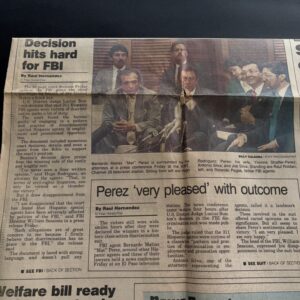
In my Oct. 1, 1988, story, I reported that Bunton packed his decision with strongly worded language, even invoking the biblical command to “love thy neighbor as thyself.” He described the bureau’s Equal Employment Opportunity system as “deficient” and in “serious need of revision.”
Hispanic agents, Judge Bunton said, should not be treated as “Anglo helpers,” used as translators for agents who didn’t speak Spanish.
“I’ve never seen a finer written opinion,” Hugo Rodriguez, an attorney for the plaintiffs, said in my article.
Fast-forward: Translating for Amber in El Paso

Years later, my friend and former reporter, Joe Olvera, recounted a familiar “Anglo helper” story from the El Paso Times newsroom in his 2007 book, Chicano — Sin Fin! — Memoirs of a Chicano Journalist.
Joe was assigned to go on an assignment with Amber, a white reporter, to translate.
“Bob, what’s the idea of assigning me to translate for Amber Smith? That was an insult of the highest degree. Bob, if you want someone to cover a story with Spanish speakers, then assign it to me or one of the other Chicano reporters,” Joe told El Paso Times City Editor Bob Locke.
“But never, ever again assign me to be an Anglo helper because I am no such thing. I am a legitimate journalist, reporter and columnist with tons of experience…”
Joe was a very good friend, a columnist and a journalist who loved to rattle cages.
Like me, he worked at both the Herald-Post and the El Paso Times. He had also freelanced for CBS in New York.
I loved watching him challenge the editors and point out the newspaper’s in-house injustices. He had the heart of a lion.
All 6 feet 3 inches of him.
Joe was vociferous, especially when standing in the middle of the newsroom protesting yet another barrio or Juarez assignment or another request to serve as a translator.
I was a rookie reporter. Unlike Joe, I would have washed cars, picked up dry cleaning or babysat white kids to keep working in that newsroom.
When I landed a job at the Herald-Post, I thought I had died and gone to heaven. So I swallowed my pride and became an “Anglo helper,” too — a newsroom translator.
Once, I was sent to translate for Herald-Post reporter Jim Braden, who was working on a feature puff piece in Juarez.
While we were there, news broke that authorities had arrested the Rio Grande Strangler, who had killed several Mexican women along the river.
I knew this was a long way from the puff piece Jim had come to write. I jumped on it.
“I got this,” I told him.
He gladly agreed to let me cover the Mexican police press conference. I wrote the story, and the editors loved it.
As my experience grew, so did my confidence. I became more vocal, more assertive.
By my later newsroom years, I had acquired an attitude. Some would call it a chip on my shoulder. I made no apologies when I believed I was being treated unfairly.
“Hey, seriously. Do I look like your gardener? Do you see a leaf blower in my hand? Am I your bitch today?”
I once told an editor.
In his book, Chicano Sin Fin! on page 35, my friend, Joe, described me as “fearless.”
I hope I didn’t let you down.
RIP, carnal.